

When the Dollar Store Is the Only Store
In parts of rural America, a dollar store isn't competition for the grocery store. It's the replacement. I've watched it happen in my own town.

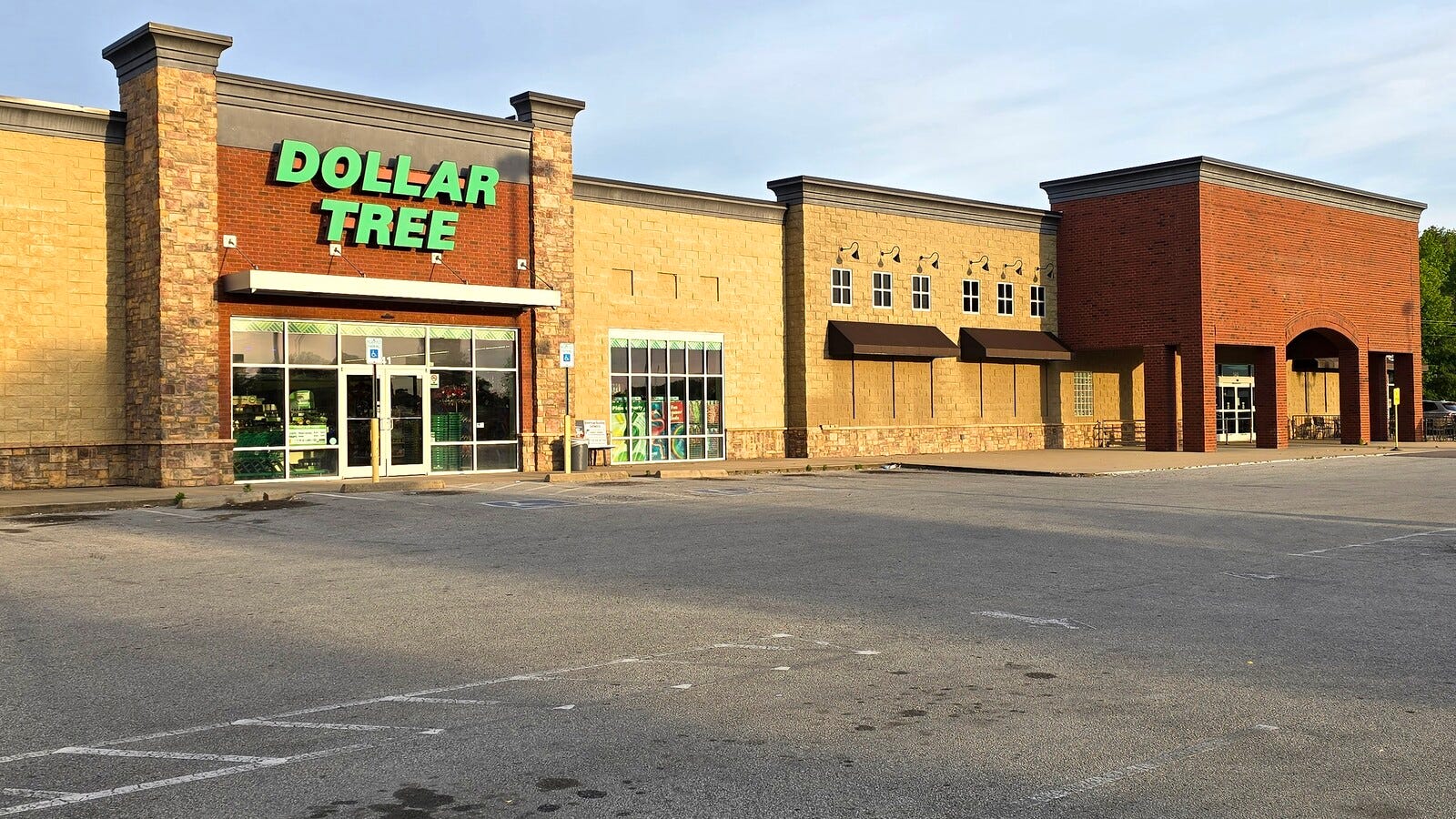
I’ve spent the first two posts of this newsletter talking about wine: geographic designations, trade policy, the informational architecture of a $18 bottle of Chianti. I promise I’ll return to all of that, and next week I’ll be writing about Belgium, beer in hand. But this week I want to talk about the other end of the food economy. Not the indulgence but the infrastructure.
When I moved to Martin, Tennessee to begin my academic career, there were four traditional grocery stores: Priceless Foods, E.W. James & Sons, Ruler Foods, and a large Wal-Mart. Fast forward eight years and only Wal-Mart and Ruler remain. Drive through West Tennessee (Weakley County, where I work, or nearby Obion, Lake, or Crockett, to name a few) and you’ll see a pattern. The small-town grocery store is gone or going. In its place, often literally in its place, is a Dollar General. Sometimes two. In some towns, the dollar store is now the primary place to buy food.
This is not a story about corporate villainy, not exactly. Dollar General isn’t doing anything illegal or even unusual. It’s following a perfectly rational business model: small footprint, low overhead, shelf-stable inventory, locations in underserved markets that larger retailers won’t touch. From a pure market-entry standpoint, it’s textbook. And for many rural consumers, a dollar store is genuinely better than nothing; it sells milk, eggs, canned goods, and basic staples at prices that undercut what a small independent grocer can offer.
But “better than nothing” is a low bar. And new research, including work by my UTM colleague Chuck Grigsby-Calage and his co-authors at the University of Florida, is beginning to quantify what happens on the other side of that trade-off.
The Study
Grigsby-Calage, along with Conner Mullally and their colleagues, published a study in the American Journal of Agricultural Economics asking a deceptively simple question: when a dollar store opens in a neighborhood, does food access get better or worse?
The answer, as is usually the case in economics, is “it depends.” In most places, the arrival of a dollar store had no measurable effect on grocery access. But in urban neighborhoods that had only a single grocery store to begin with, the opening of a dollar store was associated with a measurable decline in food access. The effect grew with each additional dollar store that opened in the same area. And the impact was concentrated in neighborhoods with larger Black populations, limited vehicle access, high reliance on public transportation, and high poverty rates.
The mechanism is straightforward: dollar stores don’t replace grocery stores, but they can undercut them just enough to push a marginal grocer out of business. A full-service grocery store operates on razor-thin margins (typically 1 to 3 percent net profit). It carries perishable inventory, employs more staff, and needs a larger customer base to break even. A dollar store needs none of that. When the dollar store siphons off enough of the shelf-stable and household goods revenue that the grocer depends on to subsidize its produce section, the math stops working. The grocery store closes. And now the dollar store, which was never designed to be a primary food source, is the only store left. Healthy options disappear, often for the most vulnerable populations.
What This Looks Like in West Tennessee
I run the Economics and Business Innovation Lab at UTM, and a significant part of our work involves regional economic analysis in the counties surrounding Martin. The USDA defines a food desert as a low-income area where residents live more than 10 miles from a supermarket. By that measure, parts of West Tennessee qualify. But the federal definition, useful as it is, misses something important: it treats food access as a binary. You’re either in a food desert or you’re not.
A town with one grocery store and two dollar stores is in a fundamentally different position than a town with one grocery store and no dollar stores, even if neither technically qualifies as a food desert. The question isn’t just whether people can get to food. It’s what kind of food, at what cost, and what the downstream effects are on health, on household budgets, on the economic viability of the town itself.
This is where the grocery store problem becomes a regional development problem. A grocery store is more than a place to buy food. It’s an employer. It’s a reason to drive into town, where you might also stop at the hardware store or the pharmacy. It’s an anchor tenant in the most literal sense. And when it closes, the other businesses on that block become more vulnerable. The loss can cascade.
Small organizations promoting local farmers markets and access to fresh produce can help. The Northwest Tennessee Local Food Network, headed by Sam Goyret and Caroline Ideus, organizes our local farmers market in Martin, connects small farmers with schools and other outlets for their produce, and conducts educational outreach. That work matters. But it is a minor salve for a larger wound in the food supply chain.
The Indulgence Gap
I called this newsletter Marginal Indulgence because I’m interested in the economics of the things we consume for pleasure: wine, cheese, craft beer, a good meal. But indulgence is a privilege that depends on infrastructure. You can’t choose between a $11 Chianti and a $18 Chianti Classico if your town doesn’t have a wine shelf. You won’t think about terroir if you’re driving 20–30 miles for fresh produce.
The gap between a community that has food choices and one that doesn’t isn’t just about income. It’s about market structure, about the conditions that allow a grocery store to survive, a farmers’ market to take root, a local food economy to function. And those conditions are shaped by the same economic forces I study in wine markets: information, regulation, competition, and the geography of where things are produced and sold.
This is the “place” part of food, drink, and place. It’s less glamorous than a Tuscan vineyard, but it’s the same discipline. And for the communities I work with in West Tennessee, it may be the part that matters most.
Anthony R. Delmond is Associate Professor of Economics at the University of Tennessee at Martin and directs the Economics and Business Innovation Lab. More at delmond.org.